

At the end of 2025, a new study reignited interest in one of the greatest mysteries in the history of writing and raised an inevitable question: does the Naibbe code explain the Voynich manuscript? The research did not present a translation or reveal a hidden meaning. Instead, it drew attention for a different reason. It demonstrated that it is possible to manually generate a text with statistical characteristics very similar to the Voynich manuscript using only data, playing cards, and substitution tables.
The author of the study is Michael Greshko, a science journalist specializing in history and science. While reviewing decades of failed attempts to decipher the Voynich manuscript, Greshko approached the problem from a different angle. What if the mystery was not about meaning, but about how the text was produced?
From this question emerged Naibbe, a name inspired by a 14th-century Italian card game. Greshko did not create the method to decipher the Voynich manuscript, but to test an unconventional hypothesis: that a text can appear deeply linguistic, organized, and intentional without necessarily conveying a readable message.
As a result, headlines began to circulate claiming that a new “code” could reproduce the behavior of the Voynich text. For many readers, this sounded like a step toward decipherment. However, what the study actually proposes is far more subtle.
Read more:
Voynich Manuscript: the undeciphered book that defies explanation
Artificial intelligence tries to decipher Voynich manuscript
The historical impasse of the Voynich manuscript

The Voynich manuscript has challenged researchers for over a century because it occupies a strange space between order and incomprehension.
The text is not random. It displays clear patterns of repetition, consistent symbol distribution, positional rules, and groupings that resemble words. At the same time, no translation attempt holds up when applied to the manuscript as a whole. No known language fits consistently. No classical cipher survives prolonged analysis.
This contrast creates the Voynich paradox:
the text behaves like language, yet refuses to be read as language.
This exact behavior is what Naibbe set out to reproduce.
How the Naibbe code works
The Naibbe method starts with an ordinary text, such as Latin or medieval Italian, and transforms it into something that cannot be read directly.
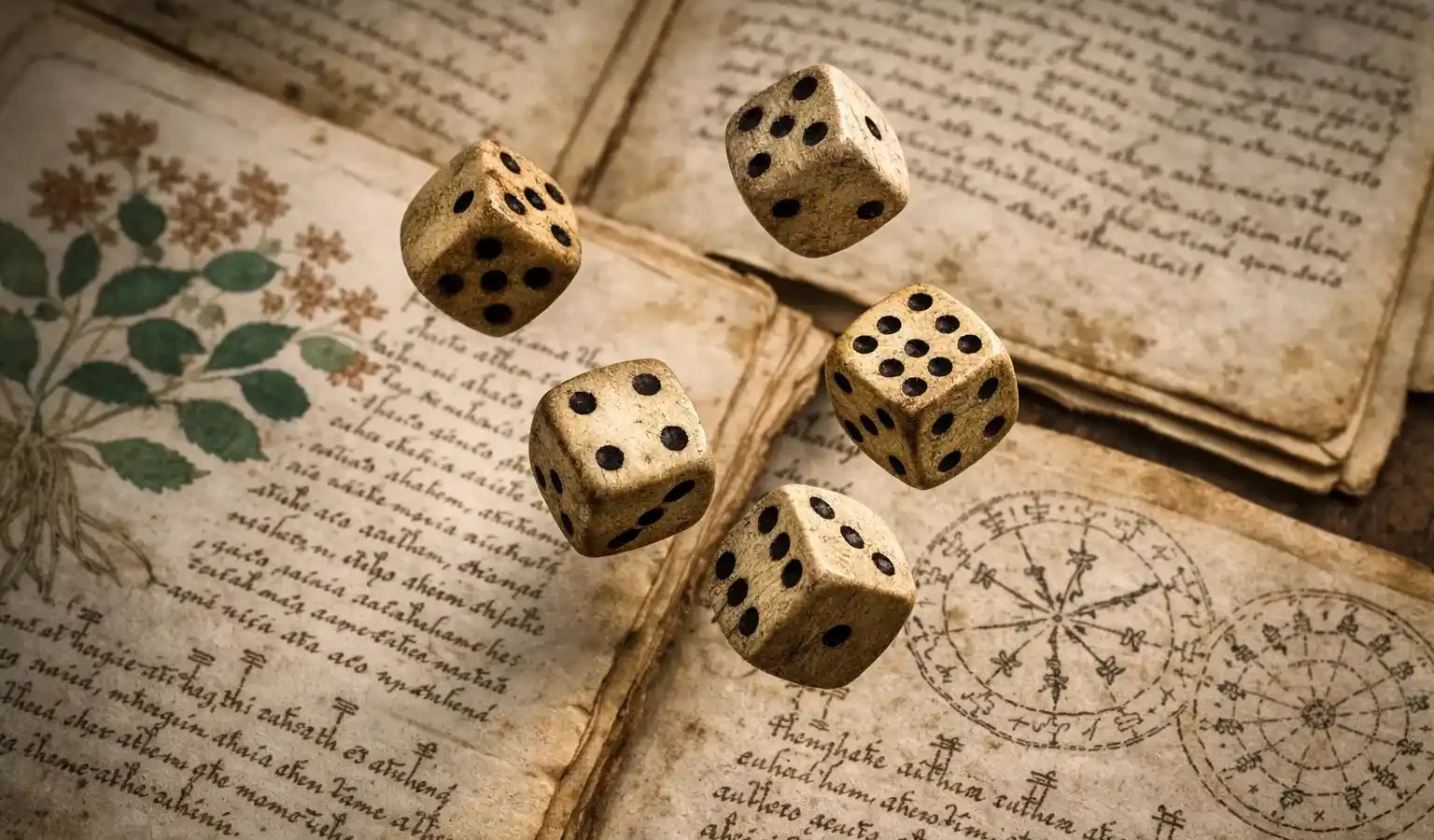
The process is simple in concept but powerful in effect. A die determines whether the system breaks the text into single letters or pairs. A playing card then selects which substitution table will be used at that moment. Each table converts these blocks into artificial glyphs, invented symbols that do not correspond directly to letters or sounds.
These tables are not neutral. They are weighted so that certain glyphs appear more frequently than others, mimicking the distribution observed in the real Voynich manuscript. The final result is a text that appears organized, coherent, and systematic, yet carries no reversible message.
The key point is that Naibbe does not attempt to read the Voynich manuscript. It attempts to imitate how the Voynich text behaves.
Why the result looks so much like the Voynich manuscript
Texts generated by the Naibbe method show objective similarities to the original manuscript.
Glyph frequencies are comparable. “Word” lengths follow similar patterns. Repetitions suggest internal rules, but without a direct link between form and meaning. To a human reader, the text seems almost readable. To statistical algorithms, it behaves like something close to a real language.
This helps explain why so many previous attempts came close to something recognizable without ever producing a consistent translation. The text deceives both human intuition and computational tools because it was designed to appear structured, not to be understood.
What Naibbe actually demonstrates
Naibbe demonstrates that it is possible to generate a text with complex linguistic appearance without that text representing a real language.
It shows that statistical patterns alone do not guarantee meaning. It also shows that a medieval scribe could plausibly execute such a method using only tools available in the 15th century. No modern technology would be required, only rules, tables, and controlled randomness.
This does not solve the Voynich mystery, but it weakens a long-standing assumption: that because the text resembles language, it must conceal a deep message waiting to be decoded.
What Naibbe does not demonstrate
At the same time, Naibbe has clear limitations.
It does not prove that the Voynich manuscript was created using this specific method. Other processes could generate similar results. It does not prove the text is a deliberate hoax, nor that it lacks symbolic intent. Most importantly, it does not provide a key that allows the manuscript to be translated.
Nothing in Naibbe makes it possible to reconstruct an original hidden text behind the glyphs.
How Naibbe relates to AI and linguistic hypotheses
Approaches based on artificial intelligence or hypotheses involving medieval Hebrew still make sense because the Voynich text genuinely exhibits patterns compatible with natural languages. Naibbe does not contradict this. Instead, it helps explain why these approaches so often “almost work.”
If a text was generated to imitate linguistic behavior, algorithms trained to detect real language will find similarities. Human readers will also recognize fragments that seem coherent. However, this logic collapses when such readings are applied to the manuscript as a whole.
Naibbe suggests that this “almost” is not an occasional failure, but a structural feature of the text.
What changes after Naibbe
For decades, the dominant question about the Voynich manuscript was:
“Which language is hidden here?”
Naibbe shifts the question to another:
“What kind of process can generate a text like this?”
This shift does not end the mystery, but it reorganizes the debate. As a result, the Voynich manuscript is no longer only a translation problem. It also becomes a question of cognition, intentionality, and human ingenuity.
Conclusion
Strictly speaking, Naibbe does not decipher the content of the manuscript. However, it reveals how the author may have produced a text without any readable message. In this sense, the system explains the mechanism of production while preserving the mystery of meaning.
The Voynich manuscript remains undeciphered. The difference is that it now seems less like an impossible object and more like a plausible product of a careful human process, capable of creating something that looks deeply like language without ever allowing itself to be read.
References
About the author of the study
Michael Greshko, science journalist and author of the study proposing the Naibbe code.
Article about the Naibbe code and the Voynich manuscript
Live Science – Mysterious Voynich manuscript may be a cipher, a new study suggests
Posts Recomendados
Carregando recomendações...